Guide
How many implants do i need?
Deciding how many dental implants you need depends on which teeth are missing and the condition of your jaw. This guide explains common implant options in the US, typical costs, and how Clarity Implants can help you find a provider who explains it clearly in your language.
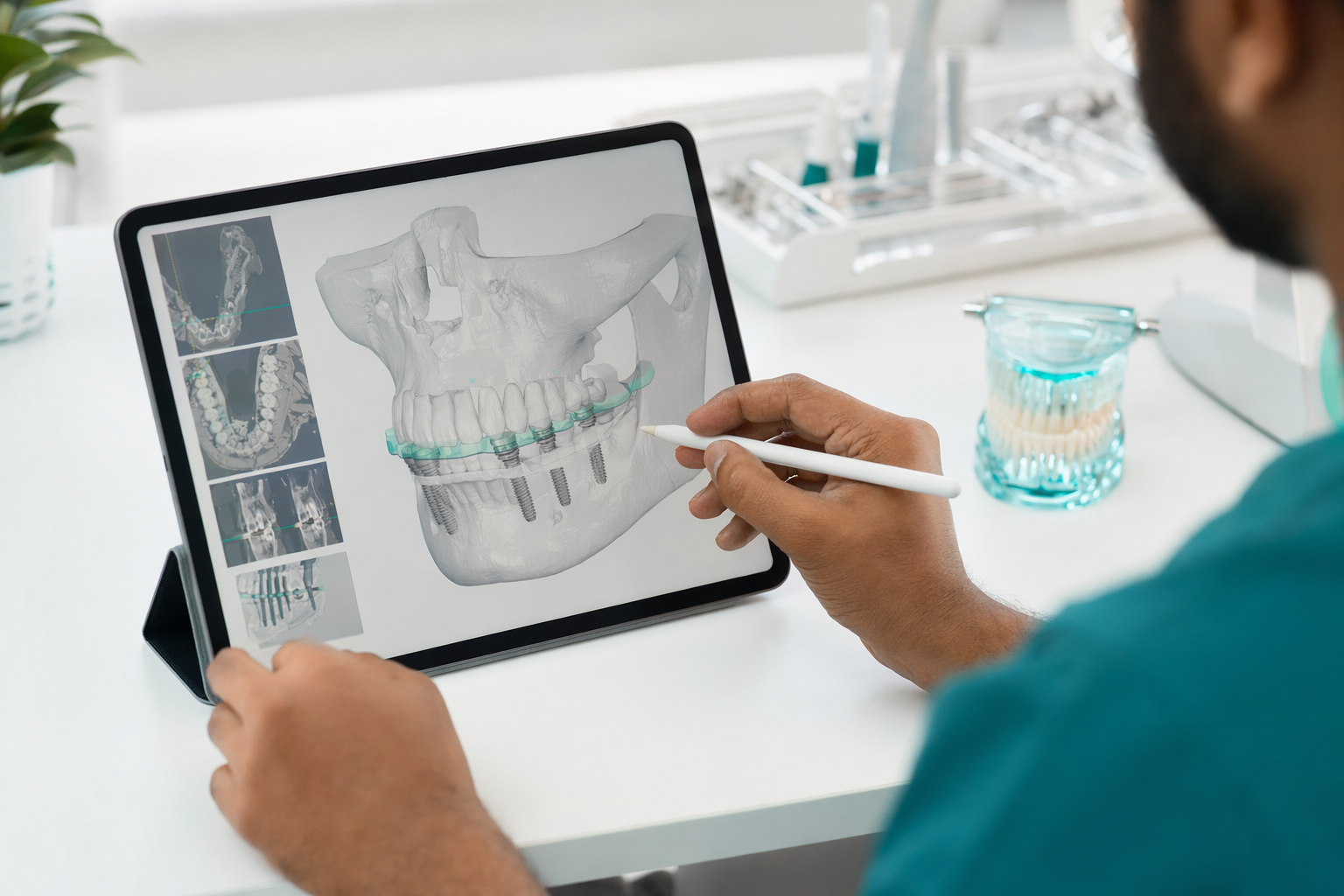
There isn’t one number for everyone
People often ask, “How many implants do I need?” The honest answer is: it depends on your specific situation. In general, your dental team looks at how many teeth are missing, where they are, how your teeth meet when you bite, and how much bone support is available.
Clarity Implants is a free matching + information service. We’re not a dental office and we can’t diagnose. But we can help you understand the common “how many implants” scenarios, the typical planning steps, and the questions to ask so you can compare options confidently.
If you’re missing one tooth, several teeth, or you’re missing most teeth on an upper or lower jaw, the implant plan often looks very different. The goal is usually to restore function (chewing) and appearance as comfortably as possible, using the fewest implants that still fit your needs.
Common implant plans (and how many implants they use)
Dental implants usually come in a few common “starting points.” The number of implants can be different for the same number of missing teeth because spacing, bite forces, and bone support vary.
Below are general examples used in the US. Your final plan depends on an in-person evaluation by a licensed dental professional.
Single-tooth replacement (often 1 implant): If only one tooth is missing, many people get one implant placed in the bone, topped with a crown. In some cases, the team may recommend adjacent options depending on the tooth position and bone support.
Multiple missing teeth (often 2–4+ implants): If you’re missing several teeth in a row, your provider may recommend multiple implants with a bridge (a “fixed” set of teeth). The number of implants depends on how long the bridge is and how much bone is available.
Full-arch replacement (often 4 to 6 implants per jaw): If most or all teeth are missing in one jaw, many people consider a full-arch setup. A common approach is “All-on-4” or “All-on-6,” meaning typically 4 or 6 implants supporting a full set of replacement teeth for that jaw. The exact count can vary based on bone shape and other factors.
Important term: osseointegration. This is when the implant fuses with the bone over time. Because this process takes healing time, treatment usually happens in steps.
How your provider decides the number of implants
Providers generally plan implant number and placement based on structure and support. While we can’t provide medical advice, here are the typical factors they consider so you know what to ask about.
Bone support and stability: Implants need enough supportive bone to hold the post safely. If bone volume is limited, some people may need additional procedures (for example, a bone graft) before or alongside implant placement. That can affect timing and total cost.
Location and load (bite forces): Back teeth often take more chewing force than front teeth. Your provider may consider implant positioning to help distribute bite forces.
Existing teeth and bite: If you still have some natural teeth, they may influence the best restoration plan. Your provider may also consider how your upper and lower teeth meet.
Using the “fewest implants possible” vs. “best support”: It’s reasonable to ask whether the plan uses the minimum number of implants that still fits your situation, and what the tradeoffs would be.
Typical US cost ranges (varies a lot by case)
Cost is one of the biggest reasons people compare options. In the US, the price depends on the number of implants, the type of restoration (crown/bridge/full arch), the provider, your city/state, and whether you need extra steps such as bone grafting or tooth removal.
Here are typical planning ranges (estimates, not quotes):
- Single implant (all-in): roughly $1,500–$6,000
- Implant bridge / several teeth (multiple implants): roughly $3,000–$15,000
- Full arch like “All-on-4” (per jaw): roughly $20,000–$50,000
These numbers are meant to help you budget. Your actual total can be higher or lower depending on your treatment plan and what’s included (for example, imaging, extractions, temporary teeth, and follow-up care).
For more on budgeting, see Implant costs in the US.
How long it takes (because healing is part of the plan)
The timeline often depends on whether you need extra steps (like bone grafting) and how fast your jaw heals. A common idea is that implants take time to heal before the final teeth can be attached.
For many people, the process is staged:
1) Planning and implant placement (a surgical step)
2) Healing time while the implant integrates with the bone
3) Attaching the abutment and then the crown/bridge/teeth set
Some people may be able to get temporary teeth during healing, but that depends on the plan and the provider’s approach.
If you’re planning your budget and time off work, ask providers what “all-in timeline” they expect for your specific plan, including any additional steps. You can also ask what happens if healing takes longer than expected—without assuming any outcome.
What to ask providers so you can compare “how many implants” clearly
When you meet a provider (or compare written treatment plans), asking clear questions can help you understand why they recommend a certain number of implants. Here are good, general questions to bring up.
- “How many implants are you recommending for my case, and what’s the main reason?”
- “Is this plan based on single-tooth, bridge, or full-arch replacement?”
- “If you recommend fewer implants, what support is used to make that possible?”
- “Do I need bone grafting or other extra steps? If yes, how does that change the number of implants and the timeline?”
- “What’s included in the estimate (imaging, extractions, temporary teeth, follow-ups)?”
- “What are the alternatives if I want a different number of implants?”
For tips on comparing practices, see Choosing an implant provider and our implant guides.
Get matched with a provider who can explain options in your language
If you want a clear explanation of how many implants you may need and what your options are, Clarity Implants can help you get matched with implant providers in the US. We’re a free service that helps you compare and connect—especially if you’re more comfortable reading or speaking in another language.
You can start here: Get matched. The process is intended for general help and scheduling. We don’t collect medical history or ask for health records.
A second opinion is normal. If you receive a recommendation for a certain number of implants, it’s okay to ask another provider to explain the reasoning in plain language.
How many implants you need depends on how many teeth you’re missing and how much bone support you have, and the best plan is different for each person—Clarity Implants helps you understand your options and connect with a provider.
Questions people ask
Why might two people with the same missing teeth need a different number of implants?
Treatment plans depend on bone support, implant placement options, bite forces, and how the restoration will be built. Even when the number of missing teeth looks similar, the jaw and spacing can be different, which can change the recommended implant count.
Does “All-on-4” always mean 4 implants?
Typically, “All-on-4” refers to a full-arch plan supported by 4 implants per jaw, but not every person qualifies for the same approach. Your provider may recommend a different number if bone support or positioning needs differ.
Will I need bone grafting, and does it change how many implants I get?
Some people need bone grafting when there isn’t enough bone volume to support implants. If additional bone work is needed, it can affect timing and sometimes the plan details, but the exact impact depends on your situation. Ask providers what they recommend and why.
How much do dental implants cost in the US?
Typical all-in estimates vary widely. As a rough planning guide: a single implant is often $1,500–$6,000; implant bridges with several teeth can be $3,000–$15,000; and full-arch options like All-on-4 can be about $20,000–$50,000 per jaw. Your case may cost more or less depending on extra steps and your location.
How long does it take to finish implant treatment?
Implant care usually takes months because healing is part of the process (osseointegration—when the implant fuses with the bone). The overall timeline depends on whether you need additional steps and how your jaw heals.
Can I choose fewer implants to save money?
You may be able to discuss options that use fewer implants, but the right choice depends on whether there is enough bone support and whether the restoration can be supported safely and comfortably. A good provider will explain the tradeoffs clearly, including costs and timing.
Keep reading
How Much Do Dental Implants Cost?
How Much Do Dental Implants Cost? — clear, honest information for people comparing dental implan
Read moreGuideHow to Pay for Dental Implants (Financing)
How to Pay for Dental Implants (Financing) — clear, honest information for people comparing dent
Read moreGuideDoes Insurance Cover Dental Implants?
Does Insurance Cover Dental Implants? — clear, honest information for people comparing dental im
Read moreNot sure where to start? We'll help — free.
Tell us your city and what you're looking for. We'll match you with vetted implant providers near you. No medical records, no pressure, and always free for patients.